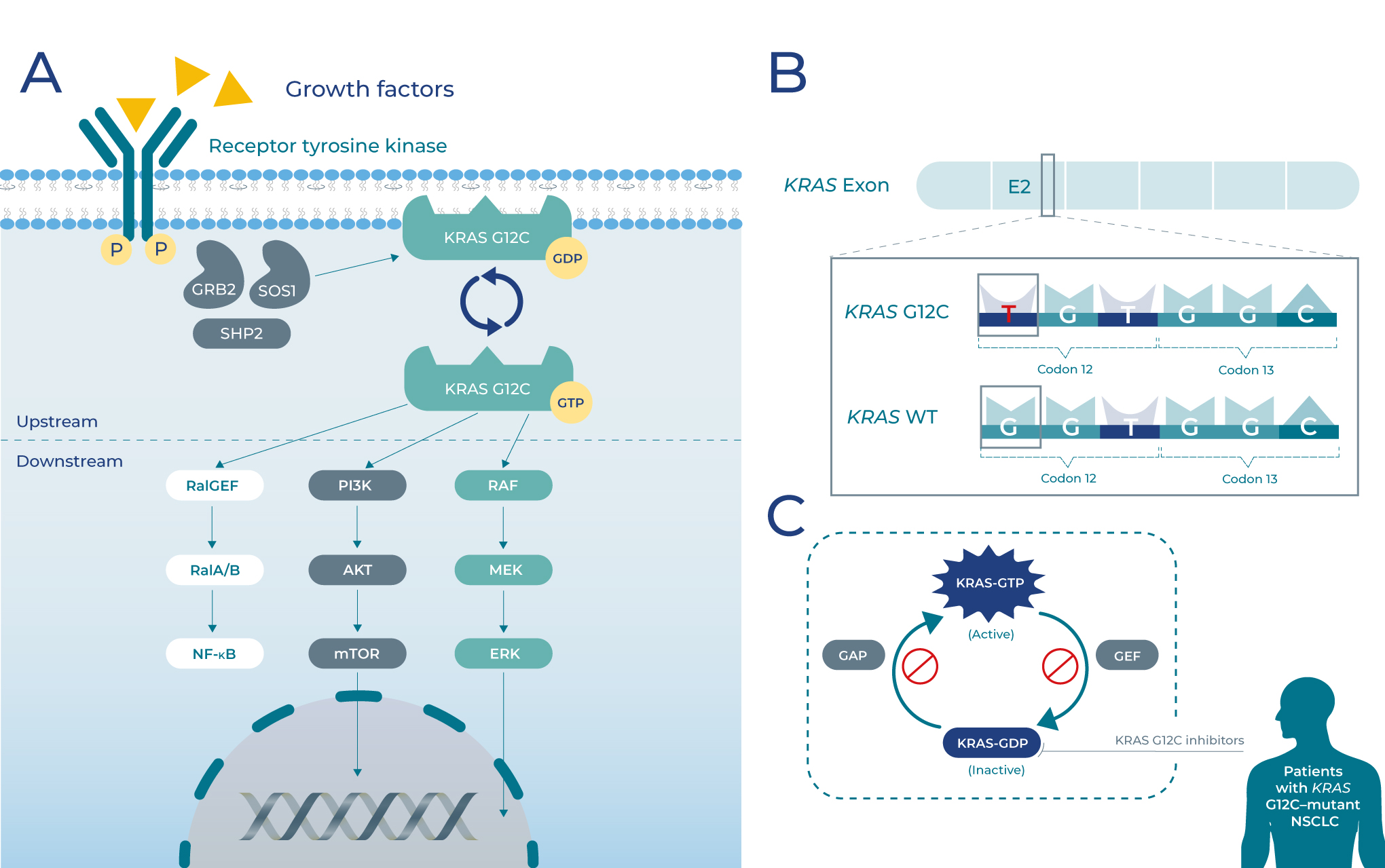
In preclinical models, inhibition of KRAS G12C suppresses downstream RAF/MEK/ERK and PI3K/AKT/mTOR signaling, leading to reduced cell proliferation, increased apoptosis, and induction of cell death in KRAS G12C–mutant tumor cells.12,13 KRAS‑mutant NSCLC exhibits increased production of pro‑tumorigenic inflammatory cytokines (eg, IL‑6) driven by KRAS‑dependent signaling pathways, including MAPK and IL‑1β/TBK1/NF‑κB signaling.14 These cytokine‑mediated autocrine and paracrine loops activate STAT3 and other survival pathways that promote tumor growth.14 Inhibition of KRAS G12C suppresses downstream pathways such as RAF, reducing tumor‑promoting signaling.14
Tumor Immune Microenvironment in KRAS G12C–Mutant NSCLC
Oncogenic KRAS mutations, including KRAS G12C, are associated with alterations in the tumor microenvironment (TME), including immune suppression and metabolic reprogramming, which contribute to immune escape.15,16 Analysis of samples from patients with lung adenocarcinoma showed that oncogenic KRAS G12C upregulates CD47, an anti-phagocytic signal.17 This upregulation occurs through PI3K/STAT3 signaling, which suppresses miR-34a and thereby releases CD47 from post-transcriptional repression. The result is reduced macrophage phagocytosis, which may help tumor cells avoid innate immune clearance.17 KRAS G12C also shapes the myeloid compartment in the TME. In NSCLC mouse models, treatment with an SHP2 inhibitor resulted in recruitment of S100A8hi granulocytic myeloid-derived suppressor cells that suppressed Klrg1+ CD8+ effector T-cell function via CXCR2 ligand signaling.18 Combining SHP2 inhibition with CXCR2 inhibition reversed this, increasing cytotoxic T-cell infiltration and improving survival in mice harboring KRAS-mutant NSCLC.18 In addition, retrospective analysis of samples from patients with NSCLC showed that patients with KRAS G12C mutations had higher levels of PD-L1 than those with KRAS non-G12C mutations, which could enhance T-cell exhaustion through PD-1/PD-L1 signaling on T cells.19
Benjamin Levy, MD, Associate Professor at Johns Hopkins School of Medicine, emphasized that the immunogenic properties of KRAS G12C set it apart from other oncogenic drivers. “KRAS G12C is different from alterations like EGFR and ALK, where checkpoint inhibitors are generally not considered a productive strategy,” said Dr. Levy. “We know that KRAS G12C is immunomodulatory—that the mutation lends itself to immune remodeling and changes the immune microenvironment in ways that make these tumors evade the immune system; however, these tumors respond to immunotherapeutic approaches.”
We know that KRAS G12C is immunomodulatory—that the mutation lends itself to immune remodeling and changes the immune microenvironment in ways that make these tumors evade the immune system; however, these tumors respond to immunotherapeutic approaches.Benjamin Levy, MD
In preclinical studies, KRAS inhibitors have been shown to remodel the TME toward an immune‑responsive state, providing a scientific rationale for combining inhibitors and immunotherapy.15,16 Inhibition of KRAS G12C in mouse models was found to shift the TME toward a pro-inflammatory state, increasing T-cell infiltration, interferon signaling, and chemokine production, and showing synergy with anti–PD-L1 therapy.20 In another preclinical study, inhibition of G12C in mice with KRAS G12C–mutant tumors reduced the numbers of immunosuppressive myeloid cells in tumors and increased the numbers of M1-polarized macrophages, dendritic cells, and CD4+ and CD8+ T cells.21 In addition, a comparison of biopsy samples from G12C inhibitor–naive and G12C inhibitor–treated patients with NSCLC showed that tumors from G12C inhibitor–treated patients had higher levels of CXCL1 and CXCL6 than those from G12C inhibitor–naive patients, further supporting the notion that targeting KRAS G12C mutations could modulate the tumor immune microenvironment.18
Co-Mutations in KRAS G12C–Mutant NSCLC
KRAS G12C mutations in NSCLC often co-occur with other mutations that may have a clinical impact. A next-generation sequencing study of samples from 772 patients with KRAS-mutant NSCLC showed that the most common co-mutations among the 352 patients with KRAS G12C were TP53 (43%), STK11 (28%), and KEAP1 (23%).19 In the PD‑L1 ≥ 50% subgroup, STK11 and KEAP1 co‑mutations were low and similar between G12C and non‑G12C tumors (STK11: 11% vs 8%; KEAP1: 11% vs 12%).19 Although the frequencies of co‑mutations were similar between G12C and non‑G12C tumors, KRAS G12C–mutant tumors exhibited a more immunogenic molecular phenotype, characterized by greater tumor mutational burden and higher PD‑L1 expression.19
Real-world data from patients with advanced KRAS G12C–mutant NSCLC treated with KRAS G12C inhibitor monotherapy (N = 424; 21 centers in the U.S./EU) suggest that co-mutations in KEAP1, SMARCA4, and CDKN2A are associated with poor outcomes.22 Mutations in KEAP1, SMARCA4, or CDKN2A were collectively present in 32% of patients with KRAS G12C–mutant NSCLC, were enriched among patients with early disease progression (PFS ≤ 3 months), and were associated with poor PFS and overall survival (OS).22 Although enriched in early progression, STK11 co-mutations alone were not associated with objective response rate (ORR), PFS, or OS.22 Mutations in DNA damage response genes (BRCA1/2, ATM, ATR, CHEK1/2, PALB2, RAD50/51 family) were associated with longer PFS.22 Co-mutations in TP53 (present in 45.7% of patients) were not associated with outcomes.22
“These co-alterations are more prognostic right now than they are predictive,” Dr. Levy said. “When STK11 or KEAP1 co-mutations occur alongside KRAS G12C, they tend to portend worse outcomes, not only with KRAS G12C inhibitors, but also with immunotherapeutic approaches. But given the pace of development of novel KRAS G12C therapies, I don’t think we are ready to stratify trials or select patients based on co-alterations occurring alongside KRAS G12C mutations.”
Co-mutations may also modulate the TME in KRAS G12C–mutant NSCLC.15 KRAS G12C–mutant tumors with concurrent TP53 mutations tend to show a hot immune phenotype characterized by higher PD-L1 expression and greater cytotoxic T-cell infiltration.23 ORR in this subgroup after treatment with immune checkpoint inhibitors (ICIs) is typically 35.7%.23 By contrast, KRAS/LKB1 co-mutations are associated with a cold TME, characterized by sparse T-cell infiltration, low PD-L1 expression, and ICI response rates below 10%.24,25
CNS Involvement in KRAS G12C–Mutant NSCLC
Central nervous system (CNS) metastases are common in patients with KRAS G12C–mutant NSCLC.26 A population-based study of the Swedish Lung Cancer Registry showed that among patients with advanced NSCLC, CNS metastasis was more common in patients with KRAS G12C mutations than in those with other KRAS mutations or wild-type KRAS. In addition, a higher proportion of patients with KRAS G12C mutations presented with CNS involvement as the sole site of distant metastasis compared to KRAS-other and KRAS–wild-type subgroups.26
Outcomes for patients with KRAS-mutant NSCLC (including those with KRAS G12C mutations) who have CNS metastases are worse than those without CNS involvement.27,28 Real-world data suggest that current standard-of-care systemic treatments for first-line KRAS G12C–mutant NSCLC (ie, immunotherapy with or without chemotherapy) show modest intracranial responses in patients with NSCLC, creating the need for treatments with CNS penetrance and intracranial efficacy.29
There remains an unmet need for more CNS-penetrant KRAS G12C inhibitors.Jonathan Riess, MD, MS
Dr. Riess acknowledged that existing KRAS G12C inhibitors have shown some intracranial activity,27,28 but underscored the limitations. “There has been modest activity shown with KRAS G12C inhibitors, such as with adagrasib showing intracranial response rates that generally track with systemic activity,” he noted. “However, there remains an unmet need for more CNS-penetrant KRAS G12C inhibitors.”
Targeting KRAS G12C Mutations in Advanced NSCLC
Approved KRAS G12C Inhibitors in Pretreated NSCLC
KRAS G12C inhibitors sotorasib and adagrasib are FDA-approved for the treatment of patients with locally advanced or metastatic NSCLC who have received at least one prior systemic therapy.3,4-7 Sotorasib and adagrasib are both first-generation inhibitors that work by irreversibly trapping KRAS in its inactive GDP-bound (RAS OFF) state.3 Next-generation inhibitors, including RAS OFF agents with improved potency and pharmacological profiles (eg, divarasib, olomorasib, calderasib) and novel RAS ON inhibitors that covalently bind the active GTP-bound form of KRASG12C, are under investigation.3
Sotorasib
Sotorasib was approved on the basis of the phase I/II CodeBreaK 100 trial.3 In the 2-year pooled analysis of CodeBreaK 100, sotorasib treatment resulted in an ORR of 41%, a median duration of response (DOR) of 12.3 months, a median PFS of 6.3 months, and a median OS of 12.5 months. Any-grade treatment-related adverse events (TRAEs) were reported in 70% (121/174) of patients, with grade 3 in 20% (34/174), and grade 4 in 1% (2/174); TRAEs led to treatment reduction or interruption in 22% (39/174) and treatment discontinuation in 6% (11/174).30
In the randomized phase III CodeBreaK 200 trial, sotorasib improved PFS compared with docetaxel (HR = 0.66 [95% CI = 0.51–0.86]; P = .0017) but did not show a significant OS advantage (HR = 1.01 [95% CI = 0.77–1.33]).7
Adagrasib
Adagrasib was approved on the basis of the single-arm phase II KRYSTAL-1 expansion cohort trial.3 Among 116 previously treated patients, the confirmed ORR was 42.9%, the median DOR was 8.5 months, the median PFS was 6.5 months, and the median OS was 12.6 months. Among 33 patients with previously treated stable CNS metastases, intracranial confirmed ORR was 33.3%.31 Any-grade TRAEs occurred in 97.4% (113/116) of the patients, and grade ≥ 3 TRAEs in 44.8% (52/116). Treatment discontinuation due to TRAEs occurred in 6.9% of patients (8/116).31
In the confirmatory, randomized, open-label, phase III KRYSTAL-12 trial, adagrasib demonstrated a significant improvement in PFS compared with docetaxel in patients with previously treated KRAS G12C–mutant advanced NSCLC (median PFS 5.5 vs 3.8 months; HR = 0.58 [95% CI = 0.45–0.76]; P < 0.0001).6 The ORR was higher with adagrasib than with docetaxel (32% vs 9%; P < 0.0001), with a median DOR of 8.3 vs 5.4 months, respectively.6 Grade ≥ 3 TRAEs occurred in 47% of patients treated with adagrasib and 46% of those treated with docetaxel; no new safety signals were identified.6
Ongoing Phase III Trials of Targeted Therapies in the First-Line Setting
Table 1 summarizes ongoing phase III trials evaluating KRAS G12C inhibitors in combination with immunotherapy, chemotherapy, or both in the first-line treatment of advanced NSCLC.